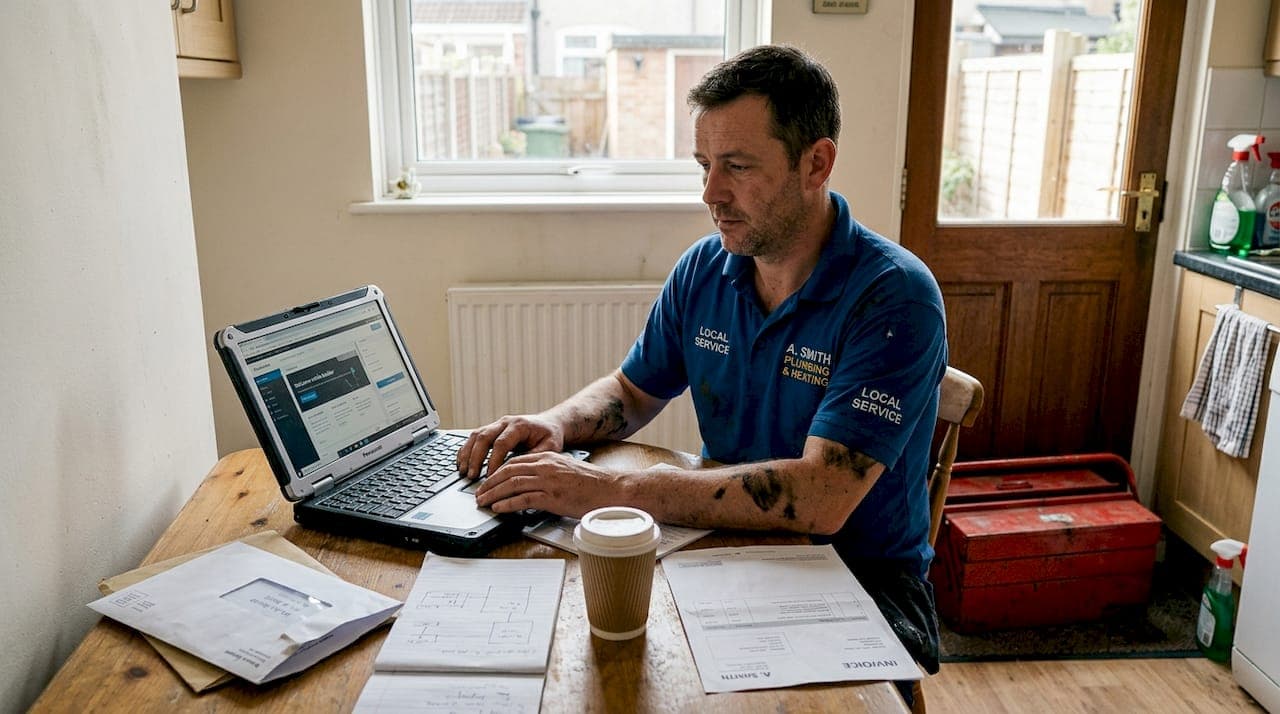
Your website looks professional, the logo is sharp, and the layout is clean. Yet the phone barely rings with new enquiries. This is one of the most common frustrations we hear from UK plumbing businesses. The problem is rarely the design. It is the content. Without a focused content strategy, even the most polished plumbing website will sit invisible in search results, losing local work to competitors who have figured out what Google actually rewards. This guide covers what a strong content strategy looks like for plumbers, the mistakes that hold most sites back, and the practical steps that turn your website into a reliable source of new leads.
Table of Contents
- Why content strategy matters for plumbers
- Planning your plumber website content
- Executing: Building and optimising your content
- Measuring success and refining your strategy
- Why most plumber websites fail and what actually works
- Get expert help with your plumber website
- Frequently asked questions
Key Takeaways
| Point | Details |
|---|---|
| Content drives leads | Strategic content like blogs and FAQs significantly increases local plumbing enquiries. |
| Plan for your audience | Identify the target clients and create relevant service pages, testimonials, and informative articles. |
| Measure and refine | Track calls, site traffic, and Google rankings to adjust your strategy for best results. |
| Ongoing beats one-off | Regular updates and reviews ensure your site stays ahead of local competition. |
Why content strategy matters for plumbers
Most plumbing business owners think about their website in terms of appearance. Does it look trustworthy? Is the phone number easy to find? These things matter, but they are not what brings in local enquiries. What drives consistent traffic and leads is content: the words, pages, blogs, and answers your site provides to people searching for a plumber right now.
Content is the engine behind local search rankings. When a homeowner in Manchester types "emergency plumber near me" at 10pm, Google serves results based on relevance, authority, and trust. All three are built through content. A site with detailed service pages, useful blog posts, and genuine customer testimonials signals to Google that it deserves a top spot. A site with thin copy and no updates signals the opposite.
The other critical point is longevity. Pay-per-click (PPC) advertising delivers a spike in traffic while you are spending. The moment you stop paying, the leads dry up. Content works differently. A well-written blog post answering a common plumbing question can attract visitors for years without additional cost. Organic trust-building through content compounds over time in a way PPC simply cannot match.
The data on this is striking. Plumbing blogs generate 67% more leads, video marketing yields 49% faster revenue growth, and email delivers an ROI of £36 for every £1 spent. These are not marginal gains. They represent a fundamentally different approach to winning work.
"Content marketing is not a quick fix. It is a long-term investment that pays dividends every month, compounding in value the longer you commit to it."
Social media often gets pushed as the answer for plumbers, but the direct ROI is low. A Facebook post about a boiler installation rarely converts into a booking. What builds trust and wins clients is useful, locally relevant website content. Here is what high-performing plumbing content looks like versus weak content:
- Strong content: Location-specific service pages, blog posts answering real questions ("why is my boiler pressure dropping?"), video walkthroughs, verified customer testimonials
- Weak content: A single homepage with a generic tagline, no blog, no FAQs, and no location references
For practical SEO tips for plumbers, the fundamentals always come back to content quality and local relevance.
Planning your plumber website content
Knowing content matters is one thing. Knowing what to create and for whom is another. Before writing a single word, you need to assess what your site currently offers and who you are trying to reach.
Start by auditing your existing pages. Does your site have dedicated service pages for each job type? Is there a blog? Are there FAQs? Is the contact form easy to find on mobile? Most plumbing sites fail at this basic level, with a single homepage doing all the heavy lifting.
Next, get clear on your audience. UK plumbing clients fall into three main groups:
- Homeowners searching for emergency repairs or boiler servicing
- Landlords needing reliable, compliant plumbing work across multiple properties
- Commercial property managers requiring scheduled maintenance and fast response times
Each group has different priorities and searches differently. A landlord searching for a gas safety certificate has different intent than a homeowner with a burst pipe. Your content needs to speak to each of these audiences directly.
Once you know your audience, map out the content types that will serve them best:
| Content type | Purpose | Frequency |
|---|---|---|
| Service pages | Rank for specific job searches | Once, then update annually |
| Location pages | Target towns and postcodes you serve | Once per area |
| Blog posts | Answer common questions, build authority | Monthly minimum |
| Testimonials | Build trust and social proof | Ongoing |
| FAQs | Capture voice search and featured snippets | Quarterly review |
A content plan does not need to be complicated. Decide on a realistic publishing frequency, assign responsibility (you, a team member, or an agency), and build a list of topics based on questions your customers actually ask.
Pro Tip: Target local keywords by combining your service with your town or area, such as "boiler repair in Leeds" or "emergency plumber Bristol." These specific phrases have lower competition and higher buying intent than broad terms.
Content strategy is long-term and delivers compounding benefits, so starting with a manageable plan you can stick to beats an ambitious one you abandon after two months. Browse website design samples for plumbers to see how structure and content work together in practice.
Executing: Building and optimising your content
With a plan in place, the practical work begins. There are certain pages every plumbing website must have before anything else.
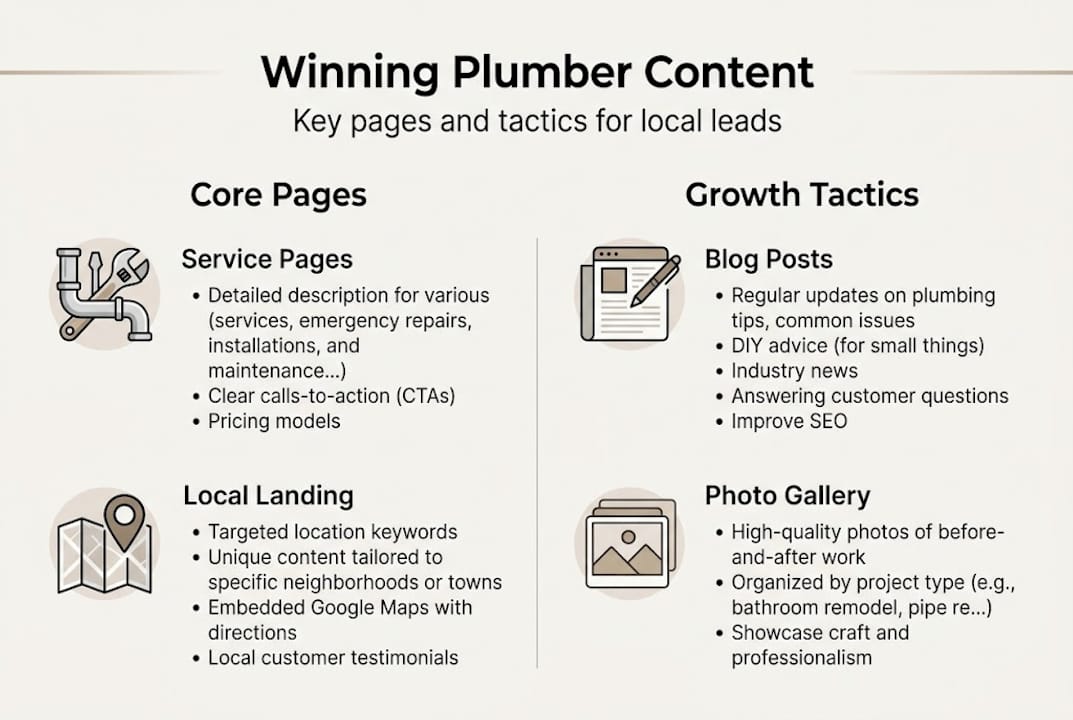
Your core pages should include:
- Homepage with a clear headline, your service area, and a prominent call to action
- Individual service pages for each job type (boiler installation, drain unblocking, bathroom fitting, and so on)
- Testimonials or reviews page with real, named customer feedback
- Contact page with a form, phone number, and your service area map
- FAQ page answering the questions customers ask before they call
Once these are live, a blog becomes your most powerful ongoing tool. Structure each post around a single question or problem. "How to fix low water pressure in a UK home" is a better blog topic than "our plumbing services." The former answers something people are genuinely searching for. The latter is a sales page dressed up as content.

The difference between a static site and one that keeps growing in rankings comes down to ongoing effort:
| Approach | What it involves | Typical outcome |
|---|---|---|
| Set and forget | Build site, never update | Rankings drop within 12 months |
| Ongoing optimisation | Regular blogs, page updates, new testimonials | Steady growth in traffic and leads |
Blogs generate 67% more leads and video accelerates revenue, so do not overlook visual content. Before-and-after photos of completed jobs are simple to produce and highly effective. A short video showing a boiler installation or explaining how to bleed a radiator builds credibility far faster than text alone.
Pro Tip: Use your smartphone to film a 60-second explainer after a job. Upload it to your website and YouTube. It takes five minutes and gives you content that works for months.
For deeper reading on SEO best practices for plumbers and how to structure pages for maximum visibility, explore the resources available on small business web design to understand what a well-built site looks like from the ground up.
Measuring success and refining your strategy
Creating content without measuring its impact is like fitting a boiler without testing the pressure. You need to know what is working so you can do more of it and cut what is not.
The key metrics to track for a plumbing website are:
- Organic traffic: How many visitors arrive from search engines each month
- Leads and calls: How many enquiries can be traced back to website visits
- Keyword rankings: Which search terms your site appears for and at what position
- Bounce rate: Are visitors reading your content or leaving immediately
- Page performance: Which service or blog pages attract the most traffic
Both Google Analytics and Google Search Console are free and give you everything you need to start. Google Search Console is particularly useful for plumbers because it shows exactly which search queries are bringing people to your site, and where you rank for them.
Common mistakes that stall progress include giving up too early (content takes three to six months to gain traction), failing to update older pages, and ignoring local intent. A blog post about "how to fix a dripping tap" will attract far more relevant visitors if it mentions your service area.
"Most plumbing businesses abandon their content strategy within three months, just before it starts to deliver results. Consistency is the competitive advantage most of your rivals will never maintain."
Testing and learning is how you refine over time. If a blog post about boiler pressure is getting strong traffic, write three more posts on related topics. If your contact page has a high exit rate, simplify the form. Measuring content ROI does not require a marketing degree. It requires checking your data monthly and making small, deliberate adjustments. Email remains one of the highest-return channels available, with email ROI as high as £36 for every £1 spent, making a simple newsletter to past customers worth building into your strategy.
Why most plumber websites fail and what actually works
After working with plumbing businesses across the UK, a pattern becomes clear. Most owners invest in a new website, wait a few months, see little change, and conclude that "the website doesn't work." The website is rarely the problem. The content is.
Off-the-shelf website templates filled with generic copy will never outrank a competitor who has spent time building locally relevant, genuinely useful content. Plumbing is not a viral industry. Nobody shares a boiler service post on Instagram. What wins clients is showing up in Google when someone in your area needs help, and being the business that looks credible and trustworthy when they land on your site.
We have seen modest plumbing websites outperform expensive ones simply because the content was specific, local, and regularly updated. A handful of well-written service pages and four blog posts per year, done consistently, will outperform a flashy site that has not been touched since launch. Browse plumbing website examples to see how this plays out in real projects. Small, ongoing improvements beat a single big launch every time.
Get expert help with your plumber website
If your website is not generating the local enquiries your business deserves, the solution is not a redesign. It is a strategy. At WebFlux, we build plumbing websites that are structured for lead generation from the ground up, with content and SEO built in from day one, not bolted on afterwards.

Our web design and SEO services are tailored specifically for UK trades businesses, and you can see live examples of what a content-led approach delivers in practice. If you are unsure where your current site is falling short, discover our process and book a free website audit. We will show you exactly what needs to change and how to make it happen.
Frequently asked questions
What is the best content for plumber websites to attract local clients?
Service pages tailored to local areas, customer testimonials, FAQs, and blogs addressing common plumbing issues are most effective. Blogs and FAQs drive more local leads than generic homepage copy alone.
How quickly will new website content generate more plumbing leads?
Content marketing usually takes three to six months to yield steady results, but lead quality and volume grow as content builds trust and visibility. SEO content compounds over time in a way paid advertising cannot replicate.
Does social media content matter for UK plumbers?
Direct ROI from social media is low for most plumbers, so focus your energy on helpful, locally optimised website content instead. Social media delivers low direct ROI compared to organic search for trades businesses.
What tools can I use to track my plumber website content's performance?
Google Analytics and Google Search Console are free, reliable options for monitoring website traffic, keyword rankings, and leads. Both tools are straightforward to set up and give you the data needed to make informed decisions about your content.